
Ayasa Instruments

Handmade in the Netherlands · since 2013

Forged from iron.
Tuned for a lifetime.

Handpans in Ember Steel® · full and warm, with a crystal-like upper register. Every instrument shaped by thousands of hammer strikes.

★ 5.0 · from 151 Google reviews

▾
2013 Handmade in the Netherlands
99%+ Never needed a retune
45 Professional artists play Ayasa
★ 5.0 From 151 Google reviews

The instruments

Ayasa Premium. No Compromise.

Every Ayasa Premium begins and ends in our workshop in Almere, the Netherlands, given the time it needs without shortcuts on tuning, and sealed in a glass-like nano coating that makes maintenance as easy as it gets. Before any instrument leaves the workshop, Ralf plays it and engraves it by hand, only then an Ayasa Premium is finished. Some models ship now, others are worth the wait; someone experienced is making this for you.

Not sure which scale is yours? Start with how you want to feel, not with theory our guide to choosing a scale can help.

New

Ayasa Elements.
Priced to open the door.

Same Ember Steel®, same shells, same shaping standards as every Ayasa and made by a dedicated team of Ayasa-trained makers. It’s not a “beginner handpan”: but a real one, at a price that makes beginning possible.

Elements instruments don’t carry the Premium line’s nano coating, so they ask a little more of you: every Elements ships with a bottle of protective oil, and a few minutes of care now and then keeps the steel as beautiful as its sound.

See all handpans

Accessories: Ayasa Softcase, Evatek 2.0 Hardcase, Phoenix Oil.

Material & craft

Why an Ayasa sounds
the way it does.

Good steel can be bought, even ours. What can’t be bought is what happens to it next. Every Ayasa is built in three stages. Unmatched is our high dynamic range; your softest touch will give the most gentle sound, whilst your hardest strike won't break the sound but gives you the volume you seek. All notes sound and play in balance with each other.

The Material

Ember Steel®, A stainless alloy we spent years of research to find: the stability of nitrided steel, the sustain of stainless. Deep-drawn to an even 1 mm nowhere thinner than 0.9. It’s the most consistent starting point in the industry. So consistent that most European handpans, whatever name they carry, begin life on Ayasa steel.

The shape

Before a shell holds a single note, its tone fields are formed. This is where an Ayasa becomes an Ayasa. Our unique shaping process gives every note field the precise geometry that decides everything after it: whether a note can be tuned true, balanced, and strong.

The tuning

Tuning techniques refined over thirteen years, passed to every Ayasa tuner through years of training. Every note is tuned precise to the cent, balanced and strong across its whole surface. Every note as strong as its neighbours, so the whole instrument sings in harmony.

Players

The other half of the sound.

Malte Marten holding a handpan against the setting sun in an open field
“The handpan is so much more than just a musical instrument… it can serve as a channel for the many emotions and feelings that we feel as human beings.”
Malte Marten 1.4M YouTube subscribers · plays mostly Ayasa

And everyone else

★ 5.0 · from 151 Google reviews.

Professionals choose Ayasa for the stage. But most Ayasa's live in living rooms, with people who simply want the best instrument they’ll ever hold. This is what they tell us:

★★★★★
Words cannot express what I feel when I play my new Ayasa handpan. I got the C Ashakiran 17, and it is an absolute dream. I have 6 handpans, and the overall quality of this handpan is in a different league. Will be purchasing from Ayasa again in the future for sureee.
Adam ColeC Ashakiran 17

Read all 151 reviews on Google →

★★★★★
OMG. My new Ayasa D Kurd 12 handpan arrived today. The difference between my first handpan (a well made and serviceable brand) and this new instrument is absolutely stunning. The new Ayasa looks almost identical to my other handpan, but the depth of sound, the breath and complexity of the harmonics, the range of dynamics and intensity are simply incredible. This instrument can produce from the softest, almost inaudible whisper, to a room-filling bellow, all with such clarity and purity of tone that it is an absolute delight to hear and play. And the variety of sounds it can produce is almost unbelievable. Wow. I’m so glad I got this thing! Thank you for crafting these instruments. It’s not an easy task to create even a basic handpan. You guys have gone so far beyond that. Your instruments are in a different class altogether. 😃
Peter OkhuysenD Kurd 12
★★★★★
Beautiful Instruments, phenomenal service. Been a long time since I was treated this well as a customer! They answered any question I had and even when the shipping company in Germany here didn’t properly do their job, they immediately contacted them and solved it all - handpan arrived directly after that. I got my hands on my second handpan from Ayasa and couldn’t be happier! They truly sound the best imo 🫶 Thanks so much for your craftsmanship
Norman DueckF# Low Pygmy 21

Since 2013 · the heart of the Netherlands

“Ayasa”, आयास,
named for the iron itself.

When Ayasa Founder Ralf played a handpan for the first time in 2012, he knew he wanted to share that sound with others. Within a year he started building his own, the start of a journey with steel: eighteen months of research and prototypes that became the first Ayasa. Each generation of instruments that followed moved closer to the sound Ralf was chasing. Six years ago came a milestone: the team landed on a steel alloy they named Ember Steel®, the stability and ceramic sound of nitrided steel, the sustain of stainless. Every Ayasa since has been shaped from it, one hammer strike at a time and the search for sound goes on.

Thirteen years later, every instrument is still made with thousands of hammer strikes, each one shaping its character. Every instrument is played for the very first time by the tuner who made it, alone in the tuning room, before anyone else in the world has heard it.

More than anything, Ayasa is a workshop of friends and family. Rick, the childhood friend who first introduced Ralf to the handpan, came to build them alongside him in 2017. He has been Ralf's right hand ever since. Roy, Ralf's twin, was travelling the world at the time; he followed soon after. Together they built a lot of what Ayasa is today. Niels, Roy and Ralf’s older brother, joined in 2020 and now runs the Maker Shop with the same care he brings to everything. And when you write to us, chances are you’ll meet Jan; the man behind more than a few of our five-star reviews. On Fridays, the workshop turns into a jam night, and the whole team is welcome to stay for dinner and play. We don’t just make handpans; we play them!
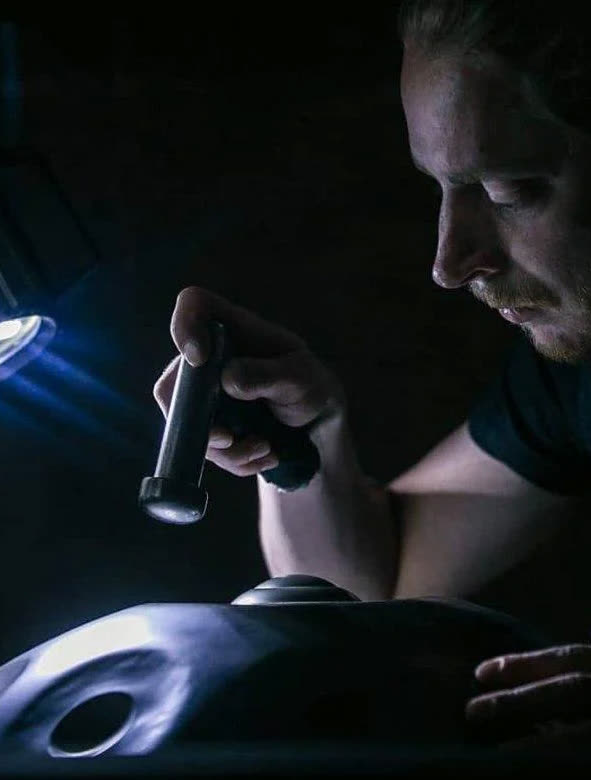
Ralf van den Bor inspecting a handpan shell by torchlight in the workshop
“You need both the player and the maker for the full symbiosis of sound. A well crafted instrument is nothing without a soulful player to give it a powerful voice.”
Ralf van den Bor · Founder, Ayasa Instruments

The practical part

Everything around the instrument,
taken care of.

With every Ayasa

A case to travel in (chosen at checkout every instrument ships protected), the Ayasa Care Kit with microfiber cloth and care sheet, and a free Ayasa t-shirt in your size. Premium instruments arrive sealed in their nano coating; Elements arrive with their bottle of protective oil.

Tuned for a lifetime

Every Ayasa comes with a two-year tuning warranty. Though the very first Ayasa Ralf ever built, thirteen years ago, still hasn’t needed a retune. If you ever doubt the tuning of your handpan, send us a short sound clip and we’ll tell you if it’s out of tune, and we can fix it up at our workshop if needed.

Shipping, insured and tracked

We ship worldwide with express carriers only; insured, tracked, and packed the way we’d want our own instruments handled. €75 within the EU, €150 to the rest of the world. For instruments in stock, typical delivery: 2–5 working days.

Or come and play them first

The best way to choose a handpan is with your own hands. Make an appointment and visit the workshop in Almere with coffee and time to try the instruments. A few times a year, we also host concerts and workshops with visiting artists.

And if it isn’t the one

Every instrument is hand-tuned, so every Ayasa has its own character and we want yours to be the one you can’t put down. If it isn’t, return it for free within 30 days.

Questions?

I’m buying my first handpan: which scale should I choose?

There are different elements that you should keep in mind when deciding on your first handpan scale.

The most sold instrument is the D-Kurd (D-Minor). The pro of this scale is that it is very versatile. Once you learn a bit how to play the scale, you can play in different moods ranging from sad, dark, melancholic to happy and euphoric! There are also many chord possibilities. What also has to be noted is that 95% of the online courses are recorded with this specific scale. Often for beginners that do not have a clear preference, we recommend the D-Kurd, it still is one of our favorite scales to play ourselves.

If you want to play together with a friend that already has a handpan, it is important to pick a similar scale, otherwise the instruments will sound dissonant when played together. You can tell us the scale that your friend has and we can let you know which scales will fit together.

In case you want to play together with other musicians, for example guitar players, it is often best to go with a natural C-Major, E-Minor or D-Minor scale. Our favourite is the D-Kurd (a natural D-Minor scale) it is also the most popular handpan scale, which means that if you might want to play with other handpan players in the future you have a good chance for a match! E minor is also great, especially when playing with guitar and concert flute the E Amara is perfect for this.

If you do not particularly have the interest of playing with others, we recommend listening to all the instruments we have listed. Listen carefully if there is any scale that resonates more with you. You canalso browse the artists pages and hear everyone play in their way on a certain scale.

Finally, we always invite you to come to our workshop to freely try out different scales and ask any questions you would like to ask. That way you can make a decision much more on your own gut feeling when you actually touch an instrument and you are also free to leave the workshop without buying an instrument, of course!

How long will my Ayasa stay in tune?

The process of making the Ayasa handpan is a very extensive one, mainly for the purpose of note stability. Our notes become so stable that they hardly ever need a retune it is what differentiates the Ayasa from many other handpans. 99% of all Ayasas ever built have never needed a retune, and every Ayasa comes with a two-year tuning warranty.

If you feel your instrument has gone out of tune, send us a sound clip where you play the note(s) you think are affected for at least 15 seconds continuously our software and ears will tell us if it’s out of tune, and at our workshop we can tune it up.

What’s the difference between Premium and Elements?

Both are made from the same Ember Steel®, on the same shells, to the same shaping standards. An Ayasa Premium begins and ends in our workshop in Almere sealed in a glass-like nano coating that makes maintenance as easy as it can get. As a last touch Ralf plays and engraves the instrument by hand by Ralf before it leaves, if it doesn't suit his standards, it does not leave the door. Elements instruments are made by a dedicated team of Ayasa-trained makers and don’t carry the nano coating: every Elements ships with a bottle of protective oil, and a few minutes of care now and then keeps the steel as beautiful as its sound.

That is what makes an Elements possible at its price. Not a “beginner handpan”: a real one, at a price that makes beginning possible.

Can I play my handpan outdoors in the sun, at the beach?

Yes, Ember Steel handpans are fine to take outdoors, and even to the beach.

One thing to know about the sun: when you play in direct sunlight for a while, the instrument slowly starts to de-tune due to the heat. Get out of direct sunlight once you hear your instrument going out of tune and let it cool down, it will come back in tune as it cools. Also be careful: an instrument left in the sun can get very hot.

How do I care for my instrument?

Every Ayasa ships with the Ayasa Care Kit; a microfiber cloth and the Ayasa care sheet.

Premium instruments arrive sealed in their nano coating, which makes maintenance as easy as it gets: an occasional wipe with the microfiber cloth is all they ask. Elements instruments don’t carry the nano coating, they ship with a bottle of protective oil, and a few minutes of care now and then keeps the steel as beautiful as its sound.

I already own a handpan, which scale should my second be?

This is a question that we get very often. But before we are able to give you a clear answer we must first determine what your wishes are for this second instrument. Would you like to have the second instrument complement your first one and increase the range that you will be able to play by combining both? Would you like to be able to play chromatically (use all 13 keys of an octave) by combining both instruments? Or would you like to be able to play together with a friend or family with both instruments? The answer to this question will drastically change the outcome of what your second instrument will be. Send us an email at info@ayasainstruments.com and we will happily help you find the scale that suits your needs best.

Are Ayasa handpans 440 Hz? Can I order custom scales?

We decided to only make our instruments in 440 Hz, because we have experienced too many disruptions in our building process when making instruments tuned to a different frequency. We prefer to make instruments that can be played with other instruments.

We have also decided not to take on custom orders anymore, and only produce sound models that we have tested and know work and sound well. You can find all the models we are taking orders for, including prices and ship dates, in the range.

How do I know a second-hand Ayasa is genuine?

If you order directly from us, you can be sure about the authenticity of your Ayasa handpan 😉 If you buy a second-hand Ayasa, you can easily verify its authenticity by the engraving on the bottom shell, stating the scale name, the year of production and the series. Ralf engraves all Ayasa handpans by hand.

More questions? Read the full FAQ →

Find your dream instrument.

Explore the instruments